

Lusha has added three things that change how it compares with other B2B data tools: a Data Waterfall that falls back to third-party providers when Lusha's own data is missing an email or phone, an MCP server for Claude, ChatGPT and other AI assistants, and a Claude plugin with pre-built prospecting skills. If you already use Lusha for one-off lookups, these make it more useful for AI agents and gap-filling. If you want a tool that checks many sources by default and then runs the whole outbound flow on its own, Parvenu is built for that.
We make Parvenu, so we're biased. Every claim about other tools below comes from their own website as of November 17, 2026.
What Lusha changed
Lusha now publishes a Releases page that lists its product updates. The ones that matter most for buyers comparing enrichment tools:
- Data Waterfall in the API (released July 27, 2026). According to the release note, "Lusha's own data is checked first, and providers fill only what is missing." It is now also available in Lusha MCP and Workspace, and it is available on all paid plans.
- Lusha MCP. Lusha's homepage says Claude, ChatGPT or any MCP-compatible assistant can work from Lusha's data in the conversation, and that you can save a list to a Workspace table or push it straight into your CRM.
- A Lusha plugin for Claude. Lusha's documentation says the plugin gives the same data access as its connector plus eight pre-built skills, including Prospect, Lookalike Prospect, Signal Prospect, Score My List and Set Up My ICP. It is available to all Lusha users, on any plan.
- Scoring and account features. Recent release entries include ICP Hub in Lusha MCP (October 5, 2026), ICP Fit Score (October 12, 2026), Signal Score and Buying Group (August 2026) and CRM AutoSync (October 26, 2026).
Put together, Lusha is moving from a contact lookup tool toward a data layer for AI agents, with scoring on top.
How Lusha's Data Waterfall works
The details are in Lusha's Data Waterfall docs:
- Lusha first, then providers. Lusha checks its own data first. If the requested email or phone is missing, it checks the providers you have enabled, in an order Lusha sets, and stops at the first successful match.
- Named providers. The docs list DataLegion, Prospeo, Techsalerator, Bytemine, Wiza and Global Database. Wiza and Global Database return results in the background, so API users have to poll for them.
- Admin set-up. An account admin enables and configures it under Account Settings, Waterfall.
- Only for contacts Lusha already has. The docs say the waterfall works on contacts Lusha already has and does not replace Search or Prospecting.
- Pricing. You pay only for successful matches: 2 credits per work email and 8 credits per phone from the waterfall, compared with 1 credit per email and 5 credits per phone for a standard Lusha reveal on the pricing page.
- Availability. API, MCP and Workspace today. Plugin support is listed as coming soon.
This is a sensible design. Lusha keeps its own database at the centre and uses outside providers only to fill gaps, which keeps costs predictable for teams that mostly find what they need in Lusha.
How this compares with Parvenu
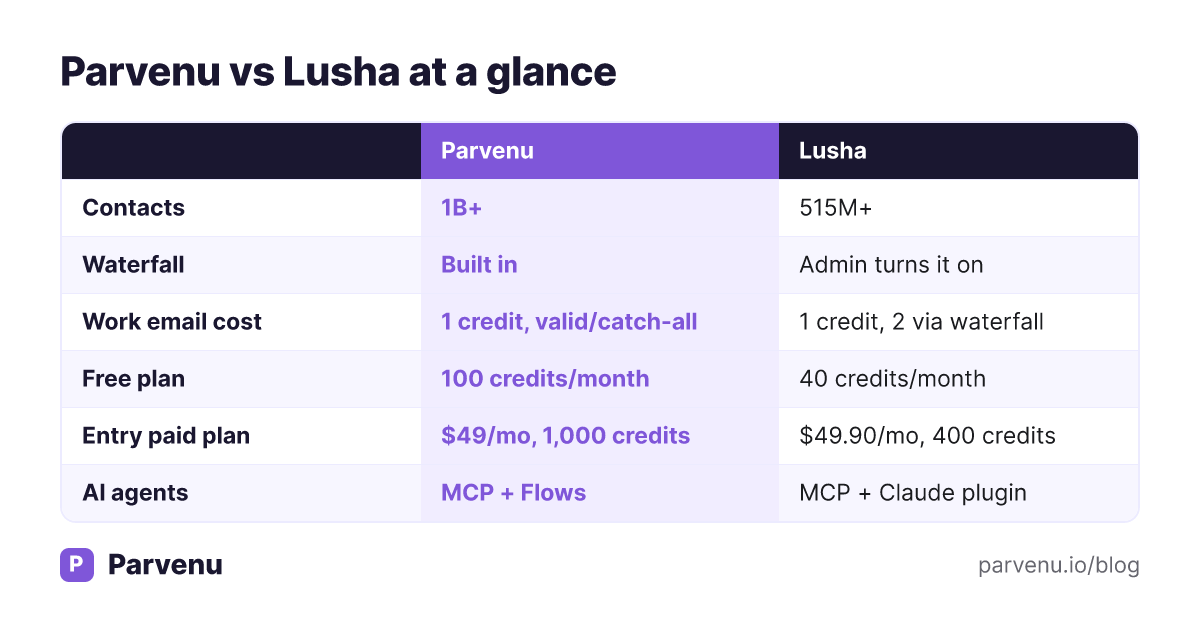
Parvenu and Lusha now overlap on waterfall enrichment, MCP and ICP scoring. The differences are in defaults, coverage and what happens after the data is found.
Data sources
- Parvenu: checks source after source for every contact until it finds a working email and phone. You never pick a provider. Parvenu's homepage lists 1B+ contacts, 68M+ companies and 125+ countries.
- Lusha: 515M+ contacts and 29M+ companies in its own database, with 165M+ verified emails, according to its homepage. The waterfall to third-party providers is an add-on an admin switches on, and it only covers contacts Lusha already has.
Email verification and what you pay for
- Parvenu: verification is built in, with no outside verifier needed. Parvenu only charges a credit if the verification status is valid or catch-all, and charges nothing for invalid, unknown or not-found emails (pricing). Finding a business email is 1 credit.
- Lusha: a verified email reveal is 1 credit, and every email comes with a confidence score and a last-updated date. Waterfall emails are 2 credits and are charged only on a match.
Automation
- Parvenu: Flows start on a new record or on market signals like funding rounds, hiring spikes, new executives and job changes. A flow can score each lead against your ICP, research the buyer, write a personalized opener with AI and send the lead to a Smartlead campaign, Google Sheets or a Parvenu list, with no one clicking through profiles.
- Lusha: Lusha tracks buying signals such as job changes, funding rounds, hiring surges and new leaders, and ranks accounts with ICP Fit Score and Signal Score. Its homepage lists Clay, Make, n8n and Zapier for automation. We did not find a built-in step on Lusha's site that writes outreach and sends it to a sequencer.
AI agents
- Parvenu: the Parvenu MCP server connects to Claude, ChatGPT and Cursor, and any MCP client works. It exposes everything in the Parvenu API, and an AI assistant can build and run Flows through it.
- Lusha: Lusha MCP works with Claude, ChatGPT and any MCP-compatible assistant, and the Claude plugin adds eight pre-built skills. Lusha's Claude plugin is the more packaged experience inside Claude today.
Pricing
- Parvenu: free plan with 100 credits a month. Paid plans start at $49 a month for 1,000 credits, with Business from $175 a month for 5,000 credits. Annual billing is 10% off, and there is a 14-day trial with 1,000 credits.
- Lusha: free plan with 40 credits a month. Starter is $49.90 a month for 400 credits, Pro is $69.90 a month for 600 credits and Premium is $399.90 a month for 3,400 credits, all billed monthly. Scale is custom through sales.
Where Lusha is a better fit
- If your reps mostly look up one contact at a time from a browser, Lusha's Chrome extension and Workspace are built for that.
- If you want a ready-made set of prospecting skills inside Claude with no set-up, Lusha's plugin is available on every plan, including free.
- If you need buying-group mapping or website visitor identification, Lusha offers both on its site. Parvenu does not list them.
- If certifications drive your vendor review, Lusha lists ISO 27701, ISO/IEC 42001, SOC 2 Type II, GDPR and CCPA on its homepage.
Where Parvenu fits
Parvenu is for teams that want outbound to run without someone stitching tools together. It checks many sources for every contact by default rather than as an add-on, verifies each email the moment it finds it, and only charges for valid or catch-all results. On a per-credit basis, the entry plan gives you 1,000 credits for $49 a month against Lusha's 400 for $49.90.
The bigger difference is what happens next. A Parvenu Flow can fire when a company raises money or starts hiring, find the right person, score them against your ICP, write a personalized opener and drop them into your sequencer. Your AI assistant can build and change that flow through the Parvenu MCP. Parvenu sends contacts to Smartlead, Instantly, Lemlist, Reply.io, HubSpot, Salesforce, Close and more. For a feature-by-feature view, see Parvenu vs Lusha.
Start on the free plan with 100 credits a month, or see Parvenu pricing.
Frequently asked questions
Does Lusha have waterfall enrichment?
Yes. Lusha's Data Waterfall, released July 27, 2026, checks Lusha's own data first and then falls back to enabled third-party providers for missing emails and phones. It is available on all paid plans in the API, MCP and Workspace.
How much does Lusha's waterfall cost?
Lusha's docs say 2 credits per work email and 8 credits per phone, charged only on a successful match.
Does Lusha have an MCP server?
Yes. Lusha MCP works with Claude, ChatGPT and any MCP-compatible assistant, and there is also a Lusha plugin for Claude with eight pre-built skills.
What is the difference between Lusha and Parvenu?
Lusha is a contact database with an optional waterfall, scoring and AI connectors. Parvenu checks many sources for every contact, verifies emails in real time and runs Flows that score leads, write openers and send them to your sequencer.
Is Parvenu cheaper than Lusha?
At the entry level, Parvenu is $49 a month for 1,000 credits and Lusha Starter is $49.90 a month for 400 credits. Parvenu's free plan has 100 credits a month and Lusha's has 40.
