

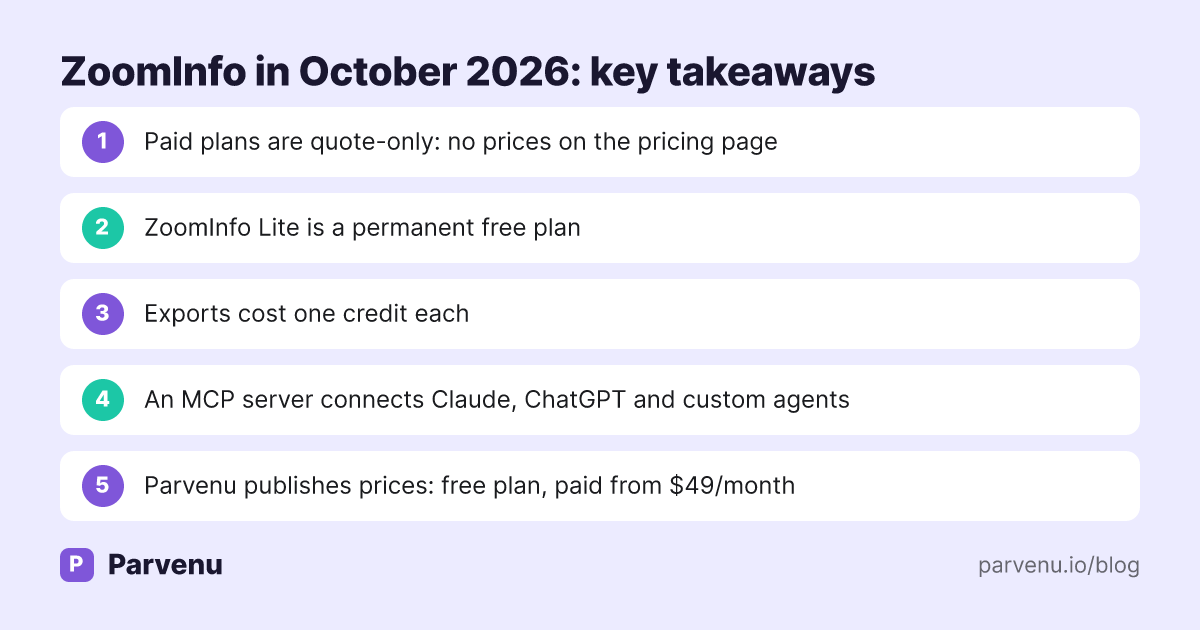
ZoomInfo does not publish prices. Its pricing page lists plan names for Sales, Marketing and Talent, but every plan leads to a trial, a demo or a "Get Pricing" form, so you only learn the cost by talking to its sales team. What has changed in 2026 is the way ZoomInfo describes itself: as an AI platform for go-to-market teams, with a free plan called ZoomInfo Lite, consumption credits and an MCP server for Claude and ChatGPT.
We make Parvenu, so we're biased. Every claim about ZoomInfo below comes from its own website as of October 27, 2026.
What ZoomInfo's pricing page shows today
- Sales plans: ZoomInfo Professional, Copilot Advanced and Copilot Enterprise. Each is a tier on top of the last. Copilot Advanced says it includes "All Professional tier features," and Copilot Enterprise includes "All Copilot Advanced features."
- Marketing plans: Marketing Demand, ABM Lite and ABM Enterprise. Marketing Demand lists 75K included credits and 25 intent topics.
- Talent: a "View pricing" link, with no plans listed on the pricing page itself.
- Prices: none. The page offers "Start free trial" or "Get a demo" buttons and a "Get Pricing" form. Its FAQ says pricing depends on features, number of licenses and credit usage, and that the sales team works out payment frequency and options with you.
- How credits are used: the FAQ says credit usage occurs only when a user exports a contact or company profile, and that each export costs one credit. Exports can come from the platform, the ReachOut Chrome extension, or API calls made by integrations.
In short, there is no number you can put in a budget until you have been through a sales conversation. You can read the page yourself at zoominfo.com/pricing.
How ZoomInfo now describes the product
ZoomInfo's products page is built around a few ideas that matter for anyone comparing tools.
- An AI platform, not just a database. The headline is "The AI platform for go-to-market teams." The FAQ calls ZoomInfo an all-in-one AI GTM platform that combines verified data on 500M+ contacts and 100M+ companies with what it calls the GTM Context Graph and AI agents that act on that data.
- A free plan. The page says "ZoomInfo Lite is a permanent free plan with no credit card required." It also describes the product as "Free to start with consumption credits based on usage."
- MCP and ChatGPT access. The page says "The ZoomInfo MCP server connects Claude, ChatGPT, and custom agents to verified ZoomInfo data." It also says developers can try ZoomInfo data headlessly for free through GTM.AI.
- Signal-triggered workflows. The product menu lists GTM Studio as a way to "Build and run GTM workflows triggered by buying signals."
That is a real shift. A year ago a buyer would have compared ZoomInfo on database size and intent data. Today the comparison also covers free entry, credit-based usage and whether an AI assistant can use the data directly.
What this means if you are choosing a data tool
- Budgeting is still a sales process. A free plan and a free trial lower the cost of looking, but the paid tiers are quote-only. If you need a price before you talk to anyone, ZoomInfo's site does not give you one.
- Credits are the unit. ZoomInfo charges credits for exports. Ask what one credit buys on your plan, what happens to unused credits, and whether API and MCP use draw from the same pool.
- MCP is now table stakes. ZoomInfo, Parvenu and several other vendors now offer an MCP server. The useful questions are what the assistant can do through it (search, enrich, build automations) and how results are billed.
- Size is not the same as fit. ZoomInfo states 500M+ contacts and 100M+ companies. Parvenu states 1B+ contacts, 68M+ companies and coverage in 125+ countries. Both are vendor claims, so the only fair test is to run the same sample list through each and count verified emails.
Where ZoomInfo is the better fit
- You want one vendor for sales, marketing and talent data, with ABM, buyer intent and advertising audiences in the same contract.
- You have a sales team that works inside ZoomInfo's own apps and wants support from a vendor with a large product line.
- You want a free plan to try a large established database before committing.
Where Parvenu fits
Parvenu is built for teams that want the finished list rather than a platform to administer. Its pricing is public. There is a free plan with 100 credits a month, and paid plans start at $49 a month for 1,000 credits. Business starts at $175 a month for 5,000 credits, Professional at $599 a month for 20,000 credits, and Enterprise is custom. Annual billing is 10% off, and there is a 14-day trial with 1,000 credits.
- Verified emails. Parvenu says every email is verified and charges a credit only when the status is valid or catch-all. Invalid, unknown and not-found results are not charged.
- Many sources, one result. Parvenu checks multiple providers in sequence for each contact. If one misses, the next one tries, and a not-found result costs nothing.
- Sourcing. You can build lists from LinkedIn searches, domains, job posts, Google Maps, lookalike audiences, a CSV, your CRM or the Chrome extension, then score each record against your ICP.
- Flows. A Flow starts on an event, such as a new record or a market signal like a funding round, hiring spike, new executive or job change. It runs enrichment, ICP scoring, If/Else branching, Research with AI and Personalize with AI, then sends the lead to Smartlead, Instantly, Lemlist or HubSpot. Credits are charged per step, so cheap checks run before expensive ones.
- MCP. Parvenu's MCP server works with Claude, ChatGPT and Cursor, which are the clients it has tested, and any MCP client can connect. You add the server URL as a custom connector and paste an API key from your dashboard. The assistant can search companies, look up contacts, create an ICP, run enrichment, download lists and build and run Flows, using the same credits as the app.
- Integrations. HubSpot, Salesforce, Close, Smartlead, Instantly, Lemlist, Reply.io, Mailshake, Google Sheets, Zapier, Make, Pabbly, Integrately and a developer API.
Parvenu does not have ZoomInfo's ABM, advertising audiences or conversation intelligence. If you need those, ZoomInfo is the better choice. For a side-by-side summary, see our Parvenu vs ZoomInfo page.
You can create a free Parvenu account and run a sample list today, or compare Parvenu plans.
Frequently asked questions
How much does ZoomInfo cost in 2026?
ZoomInfo does not publish prices. As of October 27, 2026, its pricing page lists plan names and asks you to request pricing, saying cost depends on features, number of licenses and credit usage. Pricing is on request.
Does ZoomInfo have a free plan?
Yes. ZoomInfo's products page describes ZoomInfo Lite as a permanent free plan with no credit card required. The pricing page also offers free trials for its paid plans.
Does ZoomInfo have an MCP server?
Yes. ZoomInfo's products page says its MCP server connects Claude, ChatGPT and custom agents to ZoomInfo data, and that developers can try the data headlessly through GTM.AI.
How many contacts does ZoomInfo have?
ZoomInfo states 500M+ contacts and 100M+ companies. Parvenu states 1B+ contacts at 68M+ companies in 125+ countries. These are vendor figures, so test both on a sample of your own accounts.
What is a cheaper ZoomInfo alternative?
Parvenu publishes its prices: a free plan with 100 credits a month and paid plans from $49 a month for 1,000 credits. Whether it is the right alternative depends on whether you need contact data and outbound automation or ZoomInfo's wider ABM and intent products.
Does Parvenu verify emails?
Yes. Parvenu says every email is verified and charges a credit only when the result is valid or catch-all.
