
In November 2026 ZoomInfo rebuilt its products page around one line, "The best GTM data. Orchestrated anywhere. Paid for once.", and added a section called "The waterfall is the easy part." ZoomInfo now argues that waterfall enrichment stops at the first source that answers, while ZoomInfo keeps checking, verifies across sources and offers to re-pull a record free for a year. If you use or are considering a waterfall tool, the short answer is this: the critique is fair about unverified first matches, but a waterfall that verifies every email before you pay for it answers most of it, and ZoomInfo still shows no prices.
We make Parvenu, so we're biased. Every claim about other tools below comes from their own website as of November 12, 2026.
What ZoomInfo changed
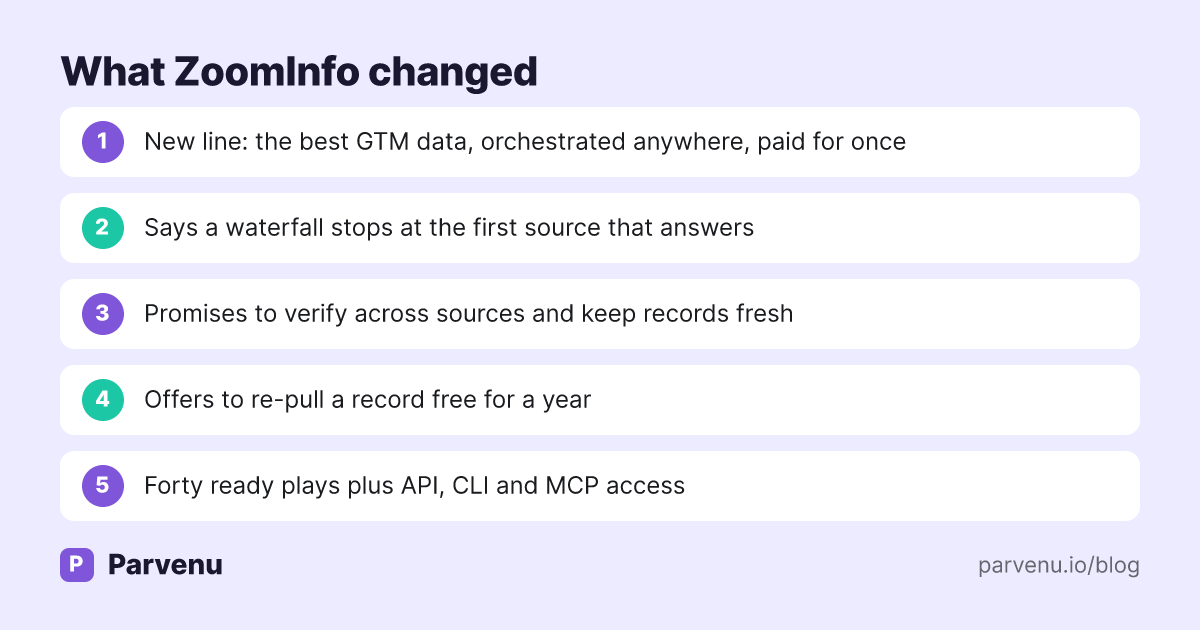
The new ZoomInfo products page presents ZoomInfo as a GTM data layer with data "verified and resolved in real time." The main changes:
- A new headline. "The best GTM data. Orchestrated anywhere. Paid for once."
- A direct challenge to waterfalls. Under "The waterfall is the easy part," ZoomInfo says a waterfall "stops at the first source that answers" and adds: "We don't stop, because a match isn't the same as an answer you can trust." Its example shows an 11-month-old record taken from the first source while two other sources disagreed and were never checked.
- A four-step process. The graphic labels ZoomInfo's steps as Check sources, Verify across sources, Add company context and Keep it fresh.
- "Pay once. Re-pull it free for a year." ZoomInfo pitches one current record that every play runs on, paid for once.
- Three layers. A data foundation, an orchestration layer with "forty plays you can run on day one" plus agents, and apps and surfaces, so you can work in ZoomInfo or from an AI agent you already use.
The ZoomInfo homepage FAQ adds that ZoomInfo has verified data on 500M+ contacts and 100M+ companies, that "300+ human researchers verify records," and that GTM.AI gives headless access "through an API, CLI, and MCP server." It says the ZoomInfo MCP server connects Claude, ChatGPT and custom agents.
Is the waterfall critique fair?
Partly. A waterfall enrichment tool sends a lookup to one data provider, and if that provider has nothing, it tries the next one. The weakness ZoomInfo points to is real: if a tool takes the first email any source returns and hands it to you without checking it, you can end up paying for an address that bounces.
The fix is not to drop the waterfall. It is to verify what the waterfall finds before you pay for it. That is the part buyers should check in any tool, ZoomInfo included:
- Is every email verified when it is found? Not in a separate tool, not a week later.
- What do you pay for? A credit per lookup, or only for results that pass verification?
- What happens when you need the same record again? Do you pay again, or is the data kept?
ZoomInfo's answer to the third question is its free re-pull for a year. That is a real benefit if you refresh the same records often, and it is something Parvenu does not offer.
How Parvenu's waterfall works
Parvenu is a data enrichment platform for sales and marketing teams. According to the Parvenu homepage, it "checks source after source" for a working email and phone: "If one provider misses, the next one tries." To be clear, that means Parvenu's waterfall moves on once a source finds an email. What happens next is what matters:
- Verification is built in. Every email is verified, with no outside verifier needed.
- You only pay for results that pass. Parvenu charges a credit only when the verification status is valid or catch-all. Invalid, unknown and not-found results cost nothing. In Parvenu's words: "No hit, no charge."
- Data you have paid for stays with the contact. When you move contacts between lists, they keep their columns and enrichment history, so you do not pay for the same data twice inside Parvenu.
- Phone numbers can be checked too. Phone validation sorts numbers into cell, landline, VOIP or fake (it uses your own Phone Validator key).
So the "stale first match" story does not describe how Parvenu bills you: an address that fails verification is not charged. What Parvenu does not do is compare several sources against each other for every record, which is what ZoomInfo describes.
Parvenu vs ZoomInfo at a glance
Pricing
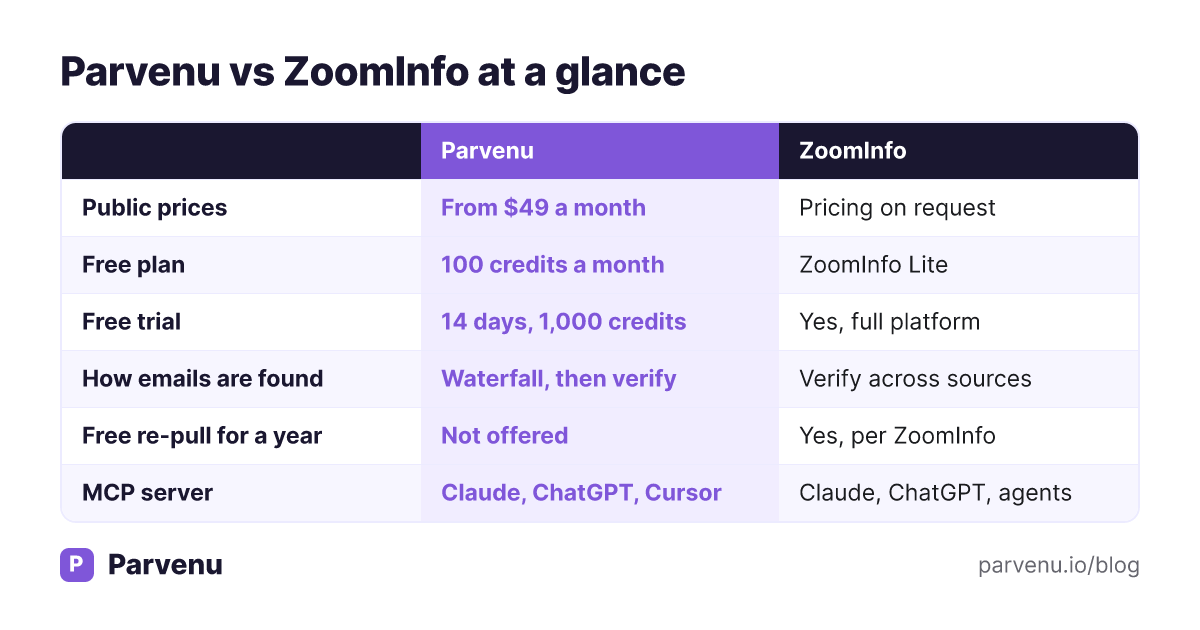
- ZoomInfo: pricing on request. The ZoomInfo pricing page shows no dollar amounts and says pricing depends on features, number of licenses and credit usage. The homepage FAQ describes ZoomInfo Lite as a permanent free plan and offers a free trial of the full platform.
- Parvenu: public prices on the Parvenu pricing page. A free plan with 100 credits a month, Startup from $49 a month for 1,000 credits, Business from $175 a month for 5,000 credits and Professional from $599 a month for 20,000 credits. Annual billing is 10% less with all credits up front. The 14-day free trial includes 1,000 credits.
Data and coverage
- ZoomInfo: 500M+ contacts and 100M+ companies, with records checked by 300+ human researchers, according to its homepage.
- Parvenu: 1B+ contacts, 68M+ companies and 125+ countries, according to its homepage. Enrichment covers verified work emails, personal emails, mobile numbers, job and education history, headcount and tech stack.
Automation and signals
- ZoomInfo: an orchestration layer with forty ready plays and agents, plus buyer intent, website visitor tracking and workflows.
- Parvenu: Flows start on funding rounds, hiring spikes, new executives, job changes or list events. Each lead is scored against your ICP, and only leads that score 70 or higher with a verified work email continue to AI research, personalised openers and your sequencer (Smartlead, Instantly, Lemlist, HubSpot and others).
AI agents and MCP
- ZoomInfo: an MCP server that connects Claude, ChatGPT and custom agents, plus an API and CLI.
- Parvenu: the Parvenu MCP server has been tested with Claude, ChatGPT and Cursor. Your AI can search, enrich, score and personalise, and it can build, edit and run Flows. It uses the same credits as the app.
When ZoomInfo is the better fit
ZoomInfo is the better choice in some cases, and it is worth saying so plainly:
- You need buyer intent data and website visitor identification in the same platform as your contact data.
- You refresh the same large set of records often, and the free re-pull for a year saves you money.
- You want human-researched records and an all-in-one platform for sales, marketing, recruiting and RevOps.
- You are a large company with a procurement process that expects a sales-led, custom package.
Where Parvenu fits
Parvenu fits teams that want to find, verify and reach the right people without a sales call or a large annual commitment:
- You can see the price before you talk to anyone, and start free with 100 credits a month.
- You pay only for valid or catch-all emails, so a waterfall miss or a failed verification costs nothing.
- Outbound runs from signals. Flows go from a funding round or new hire to a scored, verified, personalised lead in your sequencer.
- Your AI agent can run it. The MCP server works with Claude, ChatGPT and Cursor.
- It connects to your stack, including HubSpot, Salesforce, Close, Smartlead, Instantly, Lemlist, Reply.io and Mailshake, with Zapier, Make, Pabbly and Integrately for the rest.
For a fuller side-by-side, see our Parvenu vs ZoomInfo page, our earlier look at ZoomInfo pricing in October 2026, and how waterfall tools compare in Parvenu vs FullEnrich.
Try it yourself: start on the free plan or see Parvenu pricing.
Frequently asked questions
What did ZoomInfo say about waterfall enrichment?
On its products page ZoomInfo says "the waterfall is the easy part" and that a waterfall "stops at the first source that answers." It says ZoomInfo instead verifies across sources, adds company context and keeps records fresh.
Is waterfall enrichment still worth using?
Yes, if every email the waterfall finds is verified before you pay for it. Checking several providers in turn raises the chance of finding a contact. Verification is what stops you paying for addresses that bounce.
Does Parvenu charge for emails that fail verification?
No. Parvenu charges a credit only when the verification status is valid or catch-all. Invalid, unknown and not-found results are free.
How much does ZoomInfo cost?
ZoomInfo does not publish prices. Its pricing page says cost depends on features, number of licenses and credit usage, and asks you to request pricing. Its homepage mentions a free trial and a free ZoomInfo Lite plan.
Does ZoomInfo have an MCP server?
Yes. ZoomInfo says its MCP server connects Claude, ChatGPT and custom agents to ZoomInfo data. Parvenu also has an MCP server, tested with Claude, ChatGPT and Cursor, that can run full Flows.
Does Parvenu offer free re-pulls like ZoomInfo?
No. Parvenu does not offer a free re-pull for a year. Contacts keep their enrichment history when you move them between lists in Parvenu, so you do not pay twice for the same data there.
